


As a core load-bearing component of industrial vehicles, the quality of wheel rim installation directly affects vehicle safety, operational stability and the service life of the rims. Correct installation procedures and standard operating practices are key to avoiding safety hazards and ensuring optimal product performance. To assist customers in installing wheel rims correctly and to prevent issues such as deformation, loosening and air leaks caused by improper installation, we will briefly outline the installation guidelines to help every user complete the installation process safely and efficiently.
Preparations Before Installation
Tools:Prepare suitable socket wrenches, a torque wrench, a tyre changer, a tyre pressure gauge, cleaning tools (brushes, cloths) and protective equipment (gloves, safety goggles). The torque wrench must be calibrated in advance to ensure accurate torque readings and prevent bolts from loosening or becoming damaged due to torque deviations;
Check components:Verify the specifications and models of components such as rims, tyres, wheel bolts, nuts and O-rings to ensure they are fully compatible with the vehicle model and rim parameters. For custom rims, additionally verify the custom dimensions and structural compatibility with the vehicle to prevent the use of incompatible parts;
Inspection:Inspect each rim individually for defects such as deformation, cracks or corrosion; check that the tyre bead is intact and undamaged; verify that bolts and nuts are not stripped or deformed; and ensure that seals are not aged or damaged. Should any issues be identified, replace the components immediately; the use of substandard parts for installation is strictly prohibited.
Installation Procedure
Step 1: Cleaning and Preparation. Use cleaning tools to thoroughly clean the mounting surface of the wheel rim, the flange surface of the hub, and the bolt holes, removing any dust, grease, rust and debris from the surface. Ensure that the mounting surface is flat and clean to prevent contaminants from causing excessive installation clearance, which could compromise the securing effect. At the same time, clean the tyre bead and check that the contact surface between the bead and the wheel rim is intact.
Step 2: Tyre and Wheel Assembly. Place the tyre securely on the tyre changer and, following standard procedures, mount the tyre onto the wheel, ensuring the bead seats tightly against the wheel rim to prevent misalignment or jamming. After assembly, check the fit between the tyre and the wheel to ensure there is no play or misalignment.
Step 3: Fit the wheel rim. Align the assembled wheel rim with the hub flange, adjusting its position so that the wheel rim bolt holes are precisely aligned with the hub bolt holes. Hand-tighten all bolts and nuts to ensure a preliminary secure fit and prevent the wheel rim from shifting.
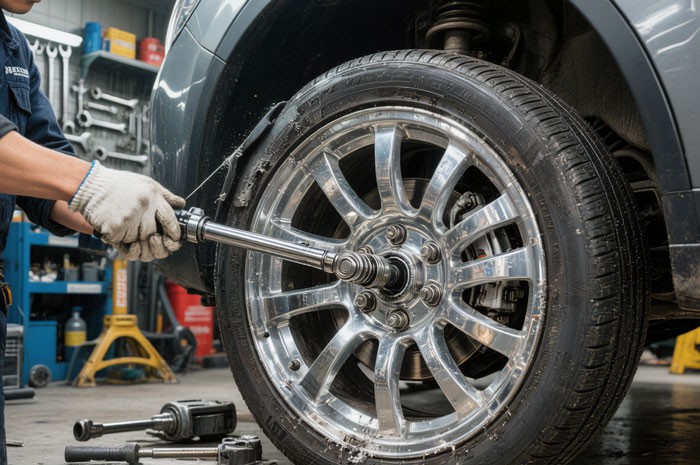
Step 4: Torque tightening. Using a calibrated torque wrench, tighten the bolts and nuts evenly in several stages, following a diagonal criss-cross pattern. Strictly adhere to the torque standards specified by the vehicle manufacturer or the rim manual. The torque range for general industrial rims is typically 120–180 N·m. Do not overtighten (which may cause bolt breakage or rim deformation) or undertighten (which may lead to loosening whilst driving).
Step 5: Inflation and inspection. Once installation is complete, use a tyre pressure gauge to check the tyre pressure and adjust it to the manufacturer's specified standard. At the same time, check the joint between the rim and the tyre for any air leaks, and observe whether the rim is wobbling or shaking. Only after ensuring there are no abnormalities should the vehicle be put into service.
Installation Precautions
1. Under no circumstances should bolts and nuts of different specifications or materials be mixed. Different rim models must be fitted with fasteners of the corresponding specifications; custom-made rims must use the manufacturer's dedicated fasteners;
2. During installation, ensure that the rim mounting surface is fully flush with the hub flange, with no gaps or misalignment. If a gap is present, check for any uncleared debris or compatibility issues with the components;
3. Torque tightening must follow a diagonal criss-cross sequence, tightening gradually in 2–3 stages to avoid uneven stress caused by tightening in a single go;
4. After installation, a test run must be carried out. After driving 1–2 kilometres at low speed, stop the vehicle to check the tightness of the bolts and nuts, and re-verify the torque using a torque wrench to ensure there is no looseness;
5. For vehicles that have been out of use for a long period or following a wheel rim replacement, tyre pressure and bolt tightness must be checked regularly during the initial driving period, and adjustments made promptly.

Summary
Correct and proper installation is essential for ensuring that the wheel rims perform to their full potential and for guaranteeing driving safety. We therefore recommend that all users strictly follow the instructions in this guide to ensure that every step is carried out in accordance with the specifications. This will effectively prevent safety hazards caused by improper installation, maximise the load-bearing capacity of the wheel rims, extend their service life, and provide a solid foundation for the stable and safe operation of the vehicle.