



When Do Crane Rims Need Five-piece Tubeless Rims?
Heavy infrastructure and mining projects in Australia, Saudi Arabia, India, Egypt, Brazil, Peru, Kazakhstan, Uzbekistan, the DRC, and South Africa use more than haul trucks. Large cranes, beam transporters, port machinery, special carriers, loaders, and mine-service vehicles create another wheel-selection problem: special machines often carry high loads but do not necessarily use the same rim geometry as mining trucks.
Crane Rims, Girder Transporter Rims, and Five-piece Tubeless Rims therefore need to be treated as separate engineering applications rather than interchangeable "heavy rims."
The recurring industry question
A frequent question from equipment users is:
"If both machines carry heavy loads, can they use the same wheel?"
Usually, the load description alone is insufficient.
The correct comparison includes:
tire dimensions;
wheel diameter and width;
center bore;
PCD;
bolt-hole arrangement;
offset;
wheel structure;
mounting surface;
rim profile;
material;
rated application;
service environment.
A heavy mining truck, crane, and girder transporter can therefore require completely different wheel geometries even when their nominal wheel diameters appear similar.
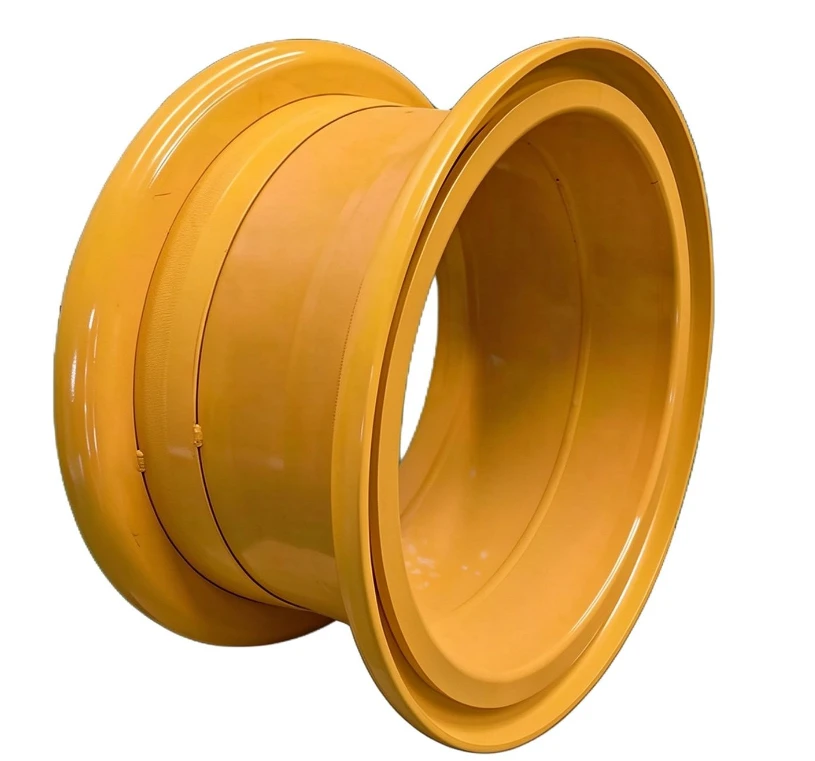
Five-piece Tubeless Rims: what does the structure change?
Five-piece Tubeless Rims normally use multiple separate components in the tire-retaining system. AQRIM explains that modular mining rims can include the rim, lock ring, side ring, and bead seat ring, with five-piece designs being a common example. (aqrim.com)
The structure can make heavy tire assembly and component servicing more practical, but it also increases the importance of correct part identification.
|
Inspection point |
Technical reason |
|
Main rim profile |
Must match tire and assembly |
|
Bead seat components |
Maintain correct tire seating |
|
Side/retaining rings |
Control tire retention geometry |
|
Locking component |
Must match exact rim design |
|
Sealing area |
Important for tubeless assemblies |
|
Corrosion / deformation |
Can affect component seating |
|
Part markings |
Prevent incompatible component mixing |
A five-piece design should therefore never be described as "more reliable" without supporting information. Reliability depends on correct material, dimensions, component matching, assembly, inspection, load conditions, and maintenance.
Crane Rims: static load is only part of the problem
Crane Rims can encounter repeated steering cycles, site travel, braking, uneven ground, and changing load distribution depending on machine configuration.
For crane procurement in Saudi Arabian infrastructure, Australian resource projects, Indian construction, or Egyptian industrial sites, buyers should provide the axle or wheel load data supplied by the equipment manufacturer as well as wheel dimensions.
The same requirement applies when replacement wheels are sourced through an aftermarket Wheel rim manufacturer. A supplier cannot confirm an application responsibly from the words "mobile crane wheel" alone.
AQRIM's special-purpose catalog includes crane and other industrial wheel categories, while its general product portfolio covers specialized wheels, engineering rims, mining wheels, and custom products. (aqrim.com)
Girder Transporter Rims need geometry first
Girder Transporter Rims serve specialized carriers used to move long structural components or bridge girders. These machines can use unusual wheel quantities and steering layouts.
For this reason, replacement-wheel procurement should begin with the original drawing or a dimensional survey.
A practical technical submission should include:
A. Tire data
Manufacturer, tire size, construction, and approved rim profile.
B. Wheel mounting data
Center bore, PCD, bolt quantity, bolt-hole diameter, mounting-face dimensions, and offset.
C. Structural data
Rim width, wheel structure, spoke/disc thickness where relevant, material, weld or cast configuration.
D. Operating data
Machine model, axle loading information, maximum operating speed specified for the equipment, and service environment.
This approach is particularly important when a machine has been modified during its service life.
Mining specifications provide a useful comparison
Even though crane and transporter wheels may differ, AQRIM's mining tables demonstrate how a technically useful wheel specification should look.
|
Mining reference |
Tire |
Center bore |
PCD |
Typical equipment |
|
25-10.00/2.0 Mining rim |
14.00-25 |
371 mm |
425 mm |
Off-highway mining truck |
|
25-11.25/2.0 Mining rim |
16.00-25 |
371 mm |
425 mm |
Heavy engineering vehicle |
|
29-13.00/2.5 Mining rim |
18.00-29 |
445.8 mm |
500 mm |
Wide-body mining truck |
The point is not to install these rims on a crane. The point is that the same dimensional discipline should be applied to Crane Rims and Girder Transporter Rims. (aqrim.com)
Regional impact for suppliers and project owners
Brazil, Peru, and the DRC have major mineral-production activities, which creates broad demand for mining infrastructure and supporting machinery. Indonesia is also a major mining economy, while Kazakhstan has a diversified mineral industry. The specific mix of wheel applications, however, must still be determined project by project rather than inferred from national mining production. (usgs.gov)
For local suppliers, this means a special-equipment inquiry should be routed through technical review rather than treated like a general spare-parts sale.
For procurement teams, it means tenders should separate Special Machinery Mining Rims, Crane Rims, Port Machinery Rims, and Girder Transporter Rims instead of grouping all products under "industrial wheels."
For government infrastructure purchasers, drawing-based technical schedules also make supplier bids easier to evaluate objectively.
Where can buyers start?
The AQRIM product catalog is useful for identifying the relevant wheel family, while the Mining Wide Body Vehicle Rims page provides examples of modular structures and maintenance considerations. For applications outside the standard catalog, AQRIM states that it supports non-standard customization based on customer requirements.
The desired result is not an unsupported promise that one rim "lasts longer." It is a purchasing process where material, tire fitment, mounting dimensions, wheel structure, manufacturing route, inspection documents, and operating conditions are defined before the product enters service.
Referenced Keywords: Crane Rims; Girder Transporter Rims; Five-piece Tubeless Rims; Special Machinery Mining Rims; Port Machinery Rims; Special Equipment Wheel Rims; Non Standard Rims; Modular Rims; Mining Wide Body Vehicle Rims; 25-10.00/2.0 Mining rim; 25-11.25/2.0 Mining rim; 29-13.00/2.5 Mining rim; Wheel rim manufacturer.