



Is a 29-13.00/2.5 Mining rim Suitable for Cold-Region Mines?
Mining and heavy industrial operations in Russia, Kazakhstan, Uzbekistan, and Ukraine introduce a different purchasing question from tropical or desert sites. Fleets may operate on rough haul roads while also dealing with seasonal temperature changes, long distances between service locations, and mixed equipment populations.
The answer is not that one specific wheel automatically becomes a "cold-climate rim." 29-13.00/2.5 Mining rim selection still depends on measurable compatibility and engineering documentation.
Kazakhstan illustrates why the issue matters. USGS reports that in 2024 the country produced a broad range of mineral commodities and ranked first globally in uranium production, while the mineral industry represented an important part of industrial output. That creates extensive demand for mining and materials-handling machinery, but it does not remove the need for machine-specific wheel selection. (usgs.gov)
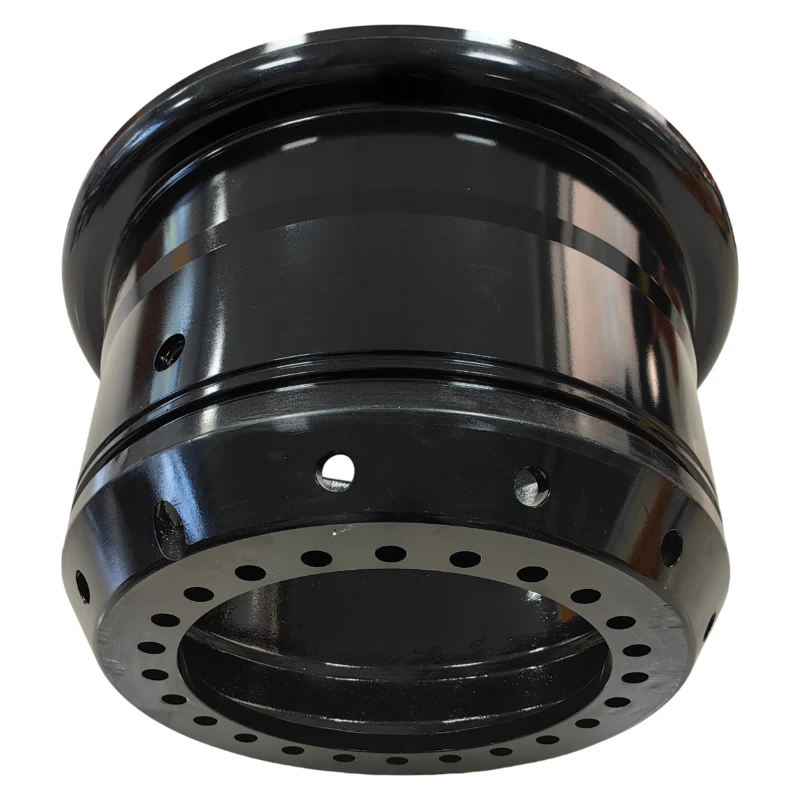
First question: what does AQRIM specify?
AQRIM provides a useful set of parameters for a 29-13.00/2.5 wheel configuration.
| Technical item | Published parameter |
| Rim specification | 29-13.00/2.5 |
| Applicable tire | 18.00-29 |
| Spoke thickness | 25 mm on listed configuration |
| Bolt arrangement | 18 × Ø27 mm |
| Center bore | 446.5 mm |
| PCD | 500 mm |
| Matching equipment | Wide Body Mining Truck |
| Published manufacturing option | Integrated weld-free alloy casting / heat treatment |
These dimensions make the specification much more useful than statements such as "heavy duty" or "high reliability." (aqrim.com)
Cast Rims: what should buyers actually examine?
Cast Rims should be evaluated by material, manufacturing process, heat treatment, inspection, dimensions, and tire compatibility.
AQRIM describes its 29-13.0/2.5 product as using high-strength alloy cast steel, integrated weld-free casting, and overall heat treatment. The same page states that completed rims undergo ultrasonic, load, and fatigue testing. These are specific process and inspection references that a procurement team can request documentation for.
In Russia, Kazakhstan, or Uzbekistan, buyers should additionally ask the supplier to confirm the material specification and applicable temperature requirements for the intended project. A general statement that a wheel "works in cold climates" should not replace verification of the relevant steel, heat-treatment condition, coating, and engineering limits.
A practical decision tree
Step 1 - Identify the tire.
If the fleet uses an 18.00-29 tire, the 29-inch diameter is one compatibility checkpoint, not the final answer.
Step 2 - Measure the hub interface.
Confirm the 445.8 mm center bore and 500 mm PCD where those figures apply. Verify all 18 bolt holes and their diameter.
Step 3 - Check wheel position.
Offset affects the wheel's location relative to the hub, suspension, brake components, and vehicle body.
Step 4 - Confirm wheel structure.
Determine whether the existing system uses a multi-piece steel rim, a tube-type configuration, a tubeless assembly, or another structure.
Step 5 - Request inspection documentation.
Material certificates, dimensional reports, and applicable nondestructive or load-test records should correspond to the actual production lot where required.
When do Non Standard Rims become relevant?
Non Standard Rims frequently appear in older fleets, modified industrial vehicles, machines sourced from several countries, or specialized equipment that uses hub geometry not found in general catalogs.
This situation can be particularly relevant in Eurasian mining operations where fleets may contain equipment from different manufacturing generations.
Customization should therefore begin with drawings rather than verbal descriptions. AQRIM states that it supports customized non-standard products and notes on its mining tables that rim dimensions, spoke thickness, and offset can be customized.
For procurement purposes, a useful drawing should show:
rim profile → tire fitment → center bore → PCD → bolt-hole size → offset → spoke thickness → valve arrangement → assembly structure.
The AQRIM 29-13.00/2.5 cast-rim page provides an example of how these parameters can be presented.
What about maintenance?
A wheel may leave the factory within specification and still develop problems if it is incorrectly installed or operated after damage.
AQRIM's maintenance guidance for mining wide-body wheels recommends cleaning mating surfaces before installation, tightening connecting bolts with a torque wrench according to specified values and sequence, checking for abnormal hub temperature, and inspecting for oil leakage or deposits associated with seal problems.
For fleets operating far from service centers, this makes maintenance documentation part of procurement rather than an afterthought.
Effect on suppliers, mines, and public procurement
A regional supplier can stock fewer unnecessary variants when fleet information is recorded by dimensional interface instead of generic equipment description.
A mining company can also separate three questions that are often mixed together:
Does it fit?
Answered by dimensions.
Is the material and process appropriate?
Answered by material documentation, manufacturing specification, and testing.
Can the site maintain it?
Answered by wheel structure, service procedures, tooling, and spare-component availability.
Public or state-linked buyers can use the same logic to write neutral tenders. Rather than requiring a marketing phrase such as "premium mining wheel," they can specify the measurable wheel interface and inspection documents.
For Russia, Kazakhstan, Uzbekistan, and Ukraine, this parameter-based method is especially valuable for mixed fleets and non-standard machinery because it makes replacement decisions traceable and technically comparable.
Referenced Keywords: 29-13.00/2.5 Mining rim; Cast Rims; Non Standard Rims; Mining Wide Body Vehicle Rims; Mining Wide Body Vehicle; Special Machinery Mining Rims; Special Equipment Wheel Rims; Underground Mining Machinery; Modular Rims; Wheel rim manufacturer.