


Which Loader Rims Work for Desert and Port Machinery?
The phrase "heavy-duty wheel" covers machines with very different duty cycles. A loader working at a quarry in Saudi Arabia does not experience the same operating pattern as a material handler at an Egyptian port, a construction loader in Algeria, or infrastructure machinery in Libya and Iraq.
This is why Loader Rims, Desert Rims, and Port Machinery Rims should be selected through machine-specific parameters rather than a single regional label.
Three operating environments, three different pain points
Desert sites: fine dust, sand ingress, high surface temperature, long travel sections, and limited shade can complicate inspection and tire maintenance.
Construction sites: loaders repeatedly accelerate, turn, brake, enter stockpiles, and travel over gravel or broken ground.
Ports and logistics yards: machinery may make frequent short cycles, carry concentrated loads, and operate around hard paved surfaces, container areas, and bulk-material terminals.
The wheel therefore needs to match the actual machine, tire, mounting interface, and duty. "Desert" or "port" alone is not an engineering specification.
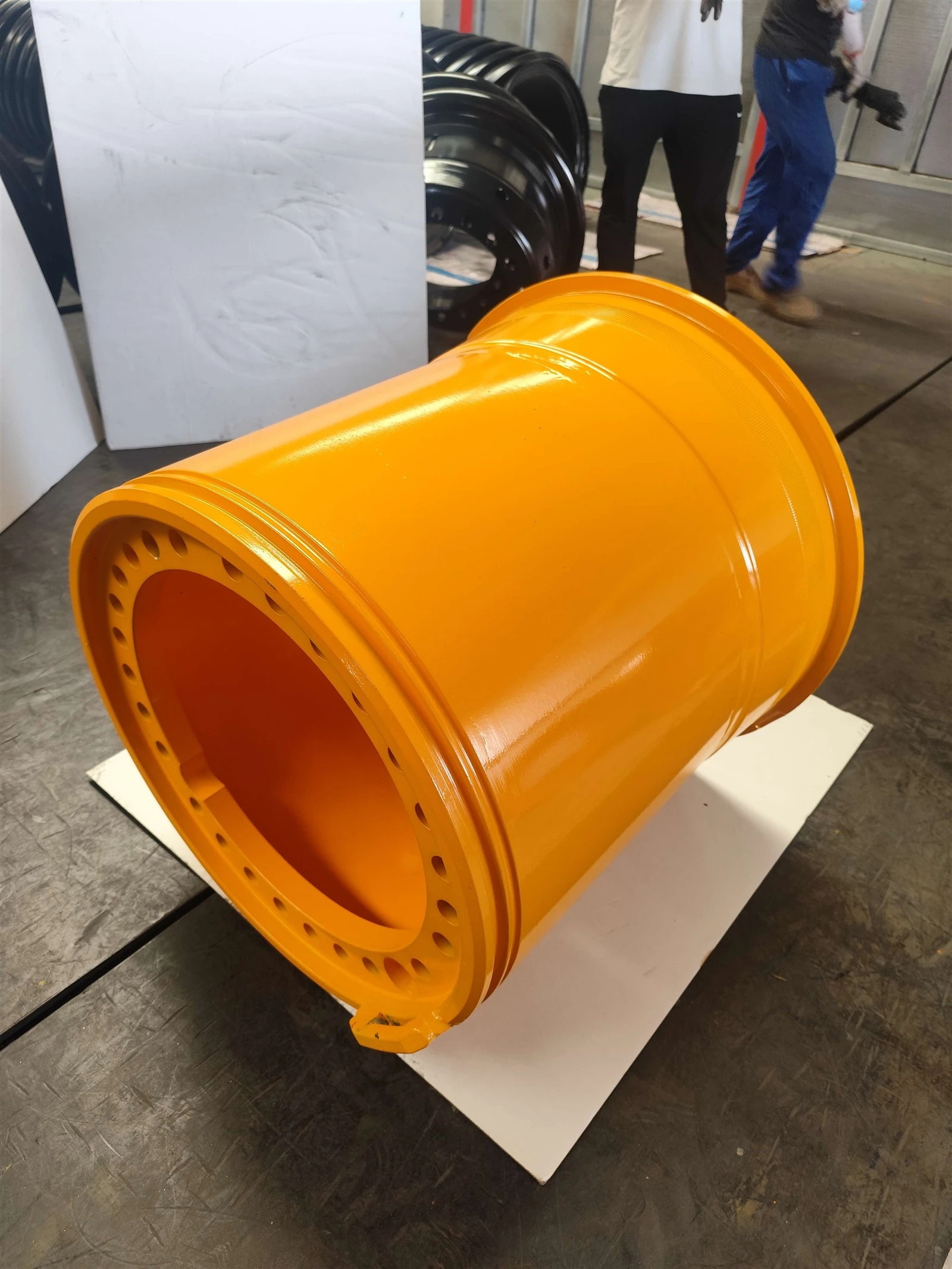
A measurable Loader Rims example
AQRIM lists a 10.00×24 Loader Steel Wheel Rim designed for medium and small wheel loaders and some light road-construction machines.
|
Parameter |
AQRIM published value |
|
Standard specification |
10.00-24 |
|
Overall diameter |
70 cm |
|
Rim width/height |
32 cm |
|
Net weight |
85.5 kg |
|
Center hole |
281 mm |
|
PCD |
335 mm |
|
Bolt pattern |
10 holes × 26 mm |
|
Offset |
110 mm |
|
Material |
Q235B, Q355B, with custom options |
|
Surface |
Yellow anti-rust coating |
|
Equipment |
Loader / road construction machinery |
These parameters support a defensible statement about compatibility. A generic claim of "consistent operation" would not. (aqrim.com)
Why Desert Rims need more than paint
Desert Rims are sometimes discussed mainly in terms of coating or appearance. That is incomplete.
For machines operating in Saudi Arabia, Egypt, Algeria, Sudan, Libya, Iraq, or Pakistan, procurement teams should examine at least four groups of information:
Geometry: tire size, rim width, center bore, PCD, bolt holes, offset.
Material: specified steel grade or alloy.
Structure: one-piece, two-piece, three-piece, five-piece, tube-type, or tubeless arrangement.
Surface protection: coating system and preparation method suited to the purchasing specification.
AQRIM's loader product uses Q235B or Q355B options and an anti-rust surface coating. Those are identifiable procurement parameters. (aqrim.com)
High-temperature operation also makes tire pressure management and inspection important, but allowable inflation pressure and temperature limits should always come from the tire and wheel documentation for the exact assembly.
Port Machinery Rims require a different checklist
Port Machinery Rims can serve equipment such as material handlers, cranes, special transport machinery, and other industrial vehicles. AQRIM's product catalog includes port and special-purpose wheel categories, while its port-selection guidance identifies several commonly encountered wheel sizes such as 14.00-24, 16.00-25, and 17.5-25 depending on equipment type. (aqrim.com)
Before replacing a port-machinery wheel, maintenance teams should record:
·machine manufacturer and model;
·axle identification;
·tire size;
·existing rim marking;
·center bore;
·PCD;
·bolt-hole quantity and diameter;
·offset;
·structure;
·wheel load requirement;
·corrosion or impact damage found during inspection.
This prevents a common supply-chain problem: receiving a wheel that matches the tire but not the hub.
What changes for local suppliers?
A distributor serving several sectors can classify stock by interface rather than by vague application name.
For example:
Group A - 10.00-24 Loader Rims
Maintain records for 281 mm center bore, 335 mm PCD, bolt geometry, 110 mm offset, and actual machine references where confirmed.
Group B - Mining Wide Body Vehicle Rims
Keep 25-inch and 29-inch configurations separate, with matching 14.00-25, 16.00-25, 18.00-25, or 18.00-29 tire data where applicable. AQRIM publishes several of these relationships in its mining range.
Group C - Port Machinery Rims or Special Equipment Wheel Rims
Use equipment drawings because specialized machines can have less standardized mounting arrangements.
This classification also helps procurement departments compare suppliers on the same technical basis.
How should buyers use online product information?
A useful product page should work as a technical screening source, not as the final engineering approval.
For example, buyers can use the AQRIM Loader Steel Wheel Rim page to identify dimensions and material options, then submit the machine model, tire, and existing wheel drawing for confirmation.
The broader AQRIM product catalog also separates mining, construction, cast, and special-purpose wheel families. The company states that its production covers mining truck wheels, engineering-vehicle tubeless steel rims, cast wheels, and wheel components. (aqrim.com)