



When Should a 25-11.25/2.0 Mining rim Replace a Standard Rim?
A common procurement mistake in India, Pakistan, Iraq, Saudi Arabia, Egypt, Algeria, Libya, and Sudan is to treat wheel diameter as the main selection criterion. A 25-inch tire does not automatically mean that every 25-inch rim can be installed.
25-11.25/2.0 Mining rim selection must begin with the complete mounting interface. AQRIM lists a 25-11.25/2.0 configuration for 16.00-25 tires, with a 371 mm center bore and 425 mm PCD in its mining-wheel specification tables. A separate cast-wheel specification lists a 23 mm spoke thickness for a 25-11.25/2.0 configuration. (aqrim.com)
Procurement problem → operating scenario → specification response
Problem: A quarry or infrastructure contractor needs replacement wheels quickly.
Scenario: Equipment operates on crushed stone, unfinished access roads, sand, or mine roads in Saudi Arabia, Egypt, Algeria, Libya, Iraq, India, or Pakistan.
Response: Procurement should compare the existing wheel drawing with the proposed rim rather than ordering from an equipment category alone.
The reason is simple. Two vehicles may both use 25-inch wheels yet differ in wheel width, PCD, bolt-hole quantity, center bore, offset, spoke thickness, or tire construction.
What does 25-11.25/2.0 actually tell a buyer?
The designation supplies useful information about the wheel profile, but it does not completely define the mounting geometry.
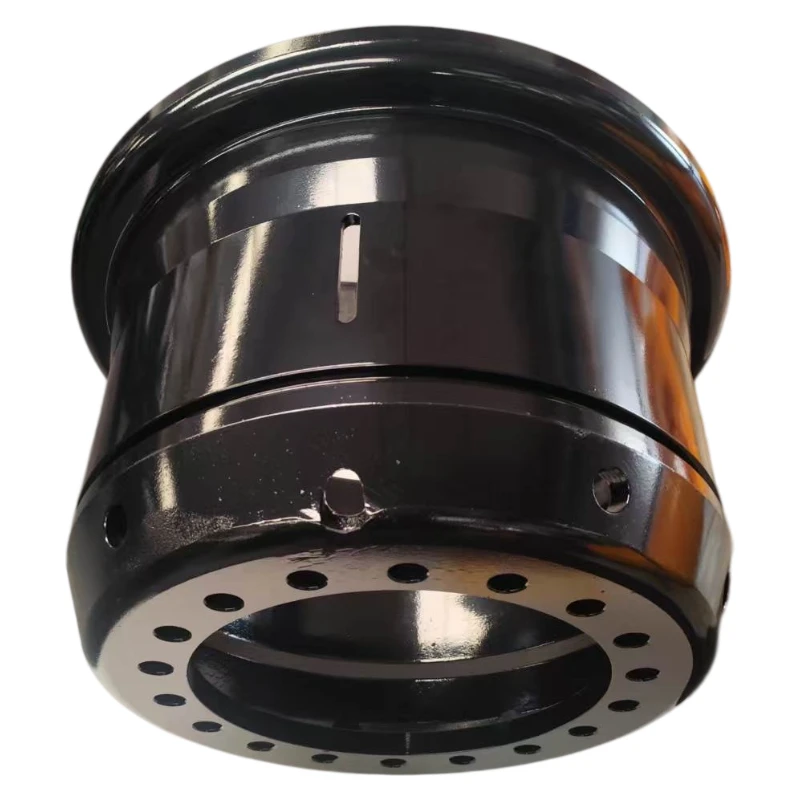
Practical product-reference table
| Item to verify | Example from AQRIM specification | Why it matters |
| Rim size | 25-11.25/2.0 | Establishes principal wheel dimensions |
| Matching tire | 16.00-25 | Prevents incorrect tire/rim pairing |
| Center bore | 371 mm | Must match the mounting interface |
| PCD | 425 mm | Determines stud-circle compatibility |
| Spoke thickness | 23 mm on listed cast configuration | Provides a measurable structural parameter |
| Structure | Multi-piece / specified product design | Changes assembly and maintenance procedure |
| Offset | Drawing-specific | Controls wheel position relative to hub |
AQRIM's mining-wheel guide specifically advises matching tire diameter and rim diameter and checking rim width, offset, and center hole. (aqrim.com)
Why regional conditions change the buying discussion
In the Gulf and North Africa, Desert Rims and Construction Rims may operate where ambient heat, fine dust, sand, and long travel distances are everyday maintenance considerations. Yet "desert specification" should never be used as a substitute for technical documentation.
For example, a supplier claiming that a wheel is "stable in desert conditions" should support the statement with measurable information: steel grade, rim dimensions, compatible tire, coating system, structure, applicable equipment, and inspection procedure.
The same principle applies in India and Pakistan, where construction, quarry, mine, road-building, and material-handling fleets can use different wheel families on the same project.
Modular Rims can change the maintenance strategy
Modular Rims generally consist of several serviceable elements rather than one permanently integrated assembly. AQRIM describes a typical five-piece arrangement as including the rim, locking component, side ring, and bead seat components. The practical advantage is not an abstract claim of "better performance." It is that some damaged components may be individually replaced, provided inspection confirms that the remaining parts are suitable for continued use.
That distinction matters for remote operations in Sudan, Libya, Iraq, Pakistan, and desert construction corridors where transporting a complete replacement wheel can take longer than replacing an approved component already held in local inventory.
However, multi-piece wheel servicing also requires trained technicians and correct assembly procedures. Lock rings and retaining components must never be treated as interchangeable merely because they appear similar.
How Construction Rims differ from mining-duty selections
Construction Rims often serve loaders, graders, cranes, and other machines that may experience different load cycles from wide-body mining haul trucks.
AQRIM's 10.00×24 loader rim, for example, is listed with:
70 cm overall diameter
32 cm rim width/height
85.5 kg net weight
281 mm center hole
335 mm PCD
10 × 26 mm bolt holes
110 mm offset
Q235B or Q355B material options
The manufacturer explicitly classifies that product within its construction-rim range rather than as a heavy mining dump-truck wheel.
This is a useful example of why categories should not be blurred. A Loader Rims specification for a medium loader should not be described as suitable for a large mining truck unless the wheel manufacturer provides a matching engineering specification.
For a closer reference, procurement teams can review the AQRIM construction machinery rim page alongside the company's mining wheel products.
How does this affect local suppliers?
Distributors in India, Egypt, Saudi Arabia, Algeria, Iraq, and Pakistan can reduce specification disputes by keeping an application database containing tire size, machine model, center bore, PCD, bolt pattern, offset, and rim structure.
Procurement departments can use the same data when preparing tenders. A tender stating "25-inch heavy-duty rim" leaves important engineering variables open. A schedule stating 25-11.25/2.0, 16.00-25 tire, specified PCD, center bore, bolt pattern, offset, material documentation, and required inspection records creates a far more auditable comparison.
That approach is also neutral between manufacturers. It does not depend on marketing language; it depends on whether the proposed component matches the required interface.
Referenced Keywords: 25-11.25/2.0 Mining rim; Modular Rims; Construction Rims; Desert Rims; Loader Rims; Mining Wide Body Vehicle Rims; Wheel rim manufacturer; Five-piece Tubeless Rims; Non Standard Rims; Special Equipment Wheel Rims.